Why Your Data Lives in Silos and What It Costs You
Most growing companies run 15 to 40 systems that have never spoken to each other. Here is what that silence is costing you - and what breaks it.
What a Data Silo Actually Is
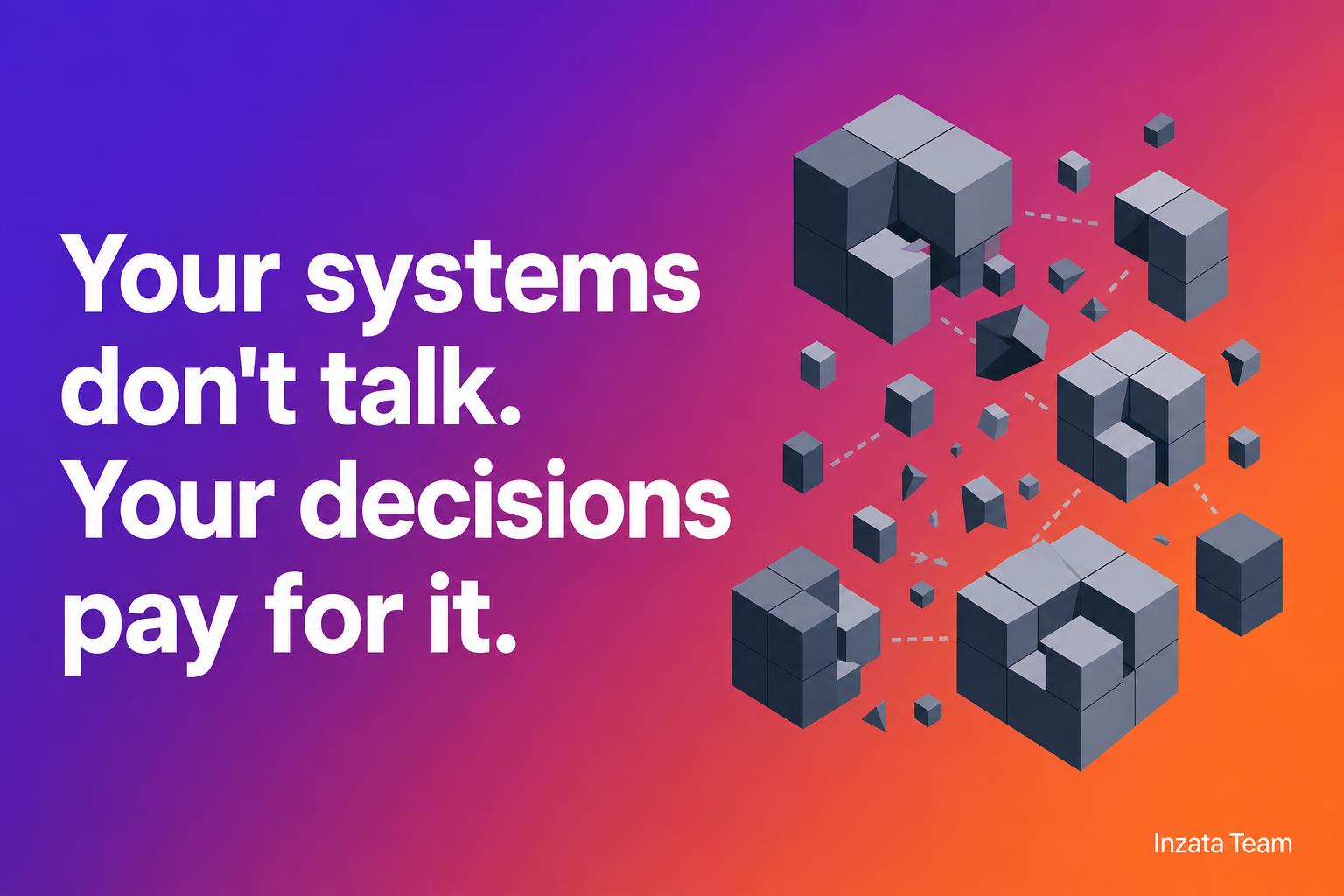
A data silo is any business system that holds records no other system can read. Your QuickBooks knows every invoice. Your CRM knows every deal. Your field service software knows every job. None of them know what the others know.
The result is that no single system can answer a cross-functional question. "Which customers are profitable but at risk of churning?" That answer lives across three systems. Without something connecting them, the question takes a week to answer manually - if anyone bothers to answer it at all.
Data silos are not a technology failure. They are a growth pattern. Every system your company added over the years solved a specific problem. None of them were designed to talk to the others.
How Companies End Up With 15 Systems That Don't Talk
The path to fragmentation is always the same. A company starts with QuickBooks and a spreadsheet. Then it adds a CRM. Then a field service platform, or a POS system, or a project management tool. Each addition solves an immediate operational problem. None of them are chosen for their ability to share data with the others.
By the time a company reaches 50 employees, it typically runs 10 to 20 systems. By 150 employees, that number is often 30 or more. Finance has its stack. Operations has its stack. Sales has its stack. Leadership sits above all of them trying to piece together a picture from export files and Slack messages.
Research from Improvado shows that 66 percent of business data sits unused in silos. Gartner estimates bad data - incomplete, outdated, or inaccessible - costs organizations an average of $12.9 million per year. For a mid-market company, the number is smaller but the proportion of impact is the same.
What Siloed Data Costs a Mid-Market Company
The cost of siloed data is not a line item on the P&L. It shows up in slower decisions, missed signals, and questions that never get asked because no one has the bandwidth to answer them.
A CFO who needs margin by customer segment has to wait for a finance analyst to pull QuickBooks data, match it to the CRM, cross-reference the job records, and build a spreadsheet. That process takes days. By the time the answer arrives, the decision has already been made on intuition.
An operations leader watching job profitability across three locations cannot see which technician-to-job combinations are losing margin. The data exists. It lives in FieldEdge, QuickBooks, and the scheduling system. Nobody has connected them.
A CEO asking "which of our customers are growing and which are at risk" cannot get a live answer from any single system. The question is reasonable. The answer is unreachable without a cross-system view.
The fragmentation tax is not just time. It is the decisions that never happen because the answer is too expensive to find.
What Breaks the Silo Problem
Traditional approaches to data silos involve data warehouses, ETL pipelines, and BI tools. These work, but they require a data team to build and maintain them, take months to stand up, and go stale as soon as systems change.
DataBlueprint takes a different approach. It connects every system read-only - QuickBooks, your CRM, your operational software, your POS - and builds a Knowledge Graph that maps how records across those systems relate to each other. No data is copied. No pipelines are built. The connections are live.
On top of that Knowledge Graph, a private LLM powered by AWS Bedrock answers questions in plain English. "Which customers drove the most margin last quarter?" gets a sourced answer in seconds, traceable to the exact rows in QuickBooks and your CRM that produced it.
Your data never leaves your environment. The private LLM powered by AWS Bedrock contractually guarantees your inputs and outputs are never used to train or improve foundation models. The Knowledge Graph connects. The LLM answers. Your leadership team gets the full picture.
What You Can Actually Ask Once Systems Are Connected
Once DataBlueprint connects your systems, the questions that used to take a week answer in seconds. Here are examples that map directly to what our customers ask on day one:
- "Which customers are growing in revenue but shrinking in job count?" (CRM + field service + QuickBooks)
- "What is our margin by service type this quarter versus last?" (QuickBooks + operational system)
- "Which locations are running below target on labor efficiency?" (scheduling + QuickBooks + HR system)
- "Show me every customer with an overdue invoice and an open support ticket." (QuickBooks + CRM + support system)
None of these questions are exotic. They are the questions your leadership team asks every week. DataBlueprint makes them answerable without a data team, a data warehouse, or a week of manual work.
What is a data silo in business?
A data silo is a business system that holds records no other system can access. When QuickBooks holds invoice data, your CRM holds deal data, and your operational software holds job data, and none of them share records, each is a silo. Leadership cannot answer cross-system questions without manual exports and spreadsheets.
Why do data silos form in growing companies?
Data silos form because each business system is added to solve a specific operational problem. Accounting software is chosen for accounting. Field service software is chosen for scheduling. Neither is chosen for its ability to share data with the other. Over time, this creates a fragmented data landscape that reflects how the company grew, not how leadership needs to see it.
How much does siloed data actually cost?
Research from Gartner estimates bad and inaccessible data costs organizations $12.9 million per year on average. For mid-market companies, the cost shows up as delayed decisions, missed signals, and questions that go unanswered because the answer is too expensive to find manually.
Do I need a data warehouse to fix data silos?
No. DataBlueprint connects your systems read-only and builds a Knowledge Graph automatically. There is no data warehouse to design, no ETL pipeline to maintain, and no data team required. The platform handles the connections and the model.
Is my data safe when connecting multiple systems?
Yes. DataBlueprint uses read-only connections to every system - it cannot write, modify, or delete any record. Your data never leaves your environment. The private LLM powered by AWS Bedrock contractually guarantees your inputs and outputs are never used to train or improve foundation models.
Your answers are trapped across systems that have never talked. DataBlueprint connects every one, builds the relationships automatically, and puts a private LLM on top. Connect your first system in under 3 minutes.
Frequently Asked Questions
What is a data silo in business?
A data silo is a business system that holds records no other system can access. When QuickBooks holds invoice data, your CRM holds deal data, and your operational software holds job data, and none of them share records, each is a silo. Leadership cannot answer cross-system questions without manual exports and spreadsheets.
Why do data silos form in growing companies?
Data silos form because each business system is added to solve a specific operational problem. Accounting software is chosen for accounting. Field service software is chosen for scheduling. Neither is chosen for its ability to share data with the other. Over time, this creates a fragmented data landscape that reflects how the company grew, not how leadership needs to see it.
How much does siloed data actually cost?
Research from Gartner estimates bad and inaccessible data costs organizations $12.9 million per year on average. For mid-market companies, the cost shows up as delayed decisions, missed signals, and questions that go unanswered because the answer is too expensive to find manually.
Do I need a data warehouse to fix data silos?
No. DataBlueprint connects your systems read-only and builds a Knowledge Graph automatically. There is no data warehouse to design, no ETL pipeline to maintain, and no data team required. The platform handles the connections and the model.
Is my data safe when connecting multiple systems?
Yes. DataBlueprint uses read-only connections to every system - it cannot write, modify, or delete any record. Your data never leaves your environment. The private LLM powered by AWS Bedrock contractually guarantees your inputs and outputs are never used to train or improve foundation models. --- Your answers are trapped across systems that have never talked. DataBlueprint connects every one, builds the relationships automatically, and puts a private LLM on top. Connect your first system in under 3 minutes. [Start for Free](https://app.inzata.ai/register) - [See how it works](/connectors)