Why BI Tools Can't Answer Your Most Important Questions
Business Intelligence tells you what happened. It was never designed to tell you what to do about it. Here is the gap - and what fills it.
What BI Tools Were Actually Built to Do
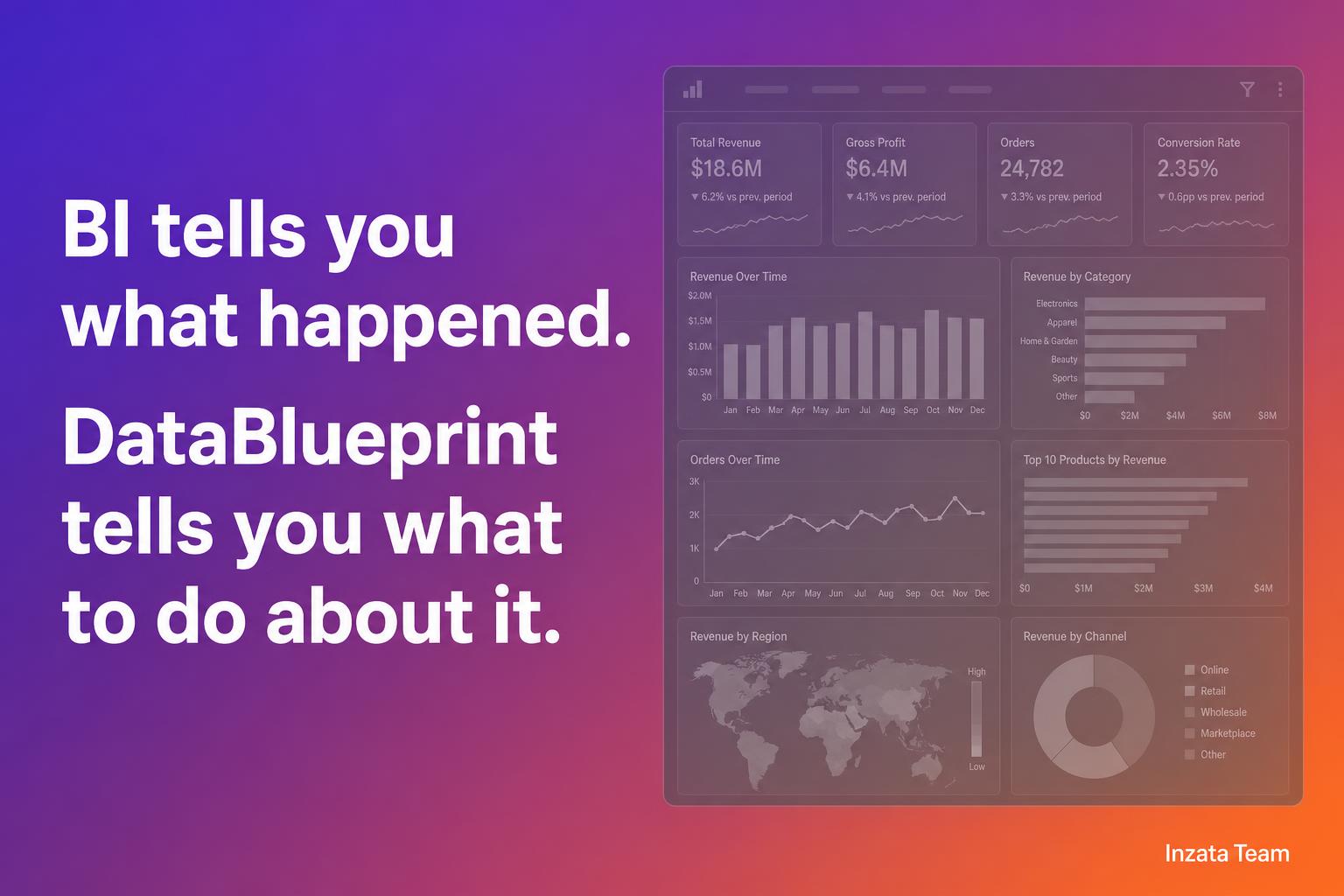
Business Intelligence tools - Tableau, Power BI, Looker, and their alternatives - were built to visualize prepared data. They take a data warehouse or a structured data source, apply transformations, and render charts and dashboards that show historical performance.
That is a genuine and useful capability. Dashboards showing monthly revenue, churn rate, or inventory turnover have driven real decisions for real companies.
The problem is that dashboards are fixed. They show the questions you thought to ask when you built them. They do not answer the questions you walk into the office with on a Tuesday morning.
And they require someone to build them. A data analyst or BI developer takes a business question, translates it into SQL, builds a view, and wires it into a dashboard. That process takes days to weeks. By the time the dashboard exists, the question has moved on.
Where BI Breaks Down for Mid-Market Leadership
BI tools were designed for organizations with data teams. A company with a staff of analysts, a structured data warehouse, and a roadmap of dashboard requests can use Tableau or Power BI effectively.
Most mid-market companies are not that company.
A 75-person professional services firm does not have a data team. Its CFO is using QuickBooks and a spreadsheet. Its COO is running operations from a project management tool. Its CEO is making growth decisions based on last quarter's reporting export.
When that CEO wants to know which clients are profitable and which are not - broken down by service type, team, and region - Tableau cannot answer that question without a data engineer building the underlying model first. Power BI cannot answer it either. Both tools need prepared, structured, centralized data. The mid-market company does not have that.
The result is that BI tools sit underutilized, maintained by one person, answering a fixed set of questions, while leadership asks their real questions in Slack and gets answers via spreadsheet three days later.
The Questions BI Cannot Answer
The most important questions in any business are cross-system questions. They require records from multiple operational systems to answer.
"Why did our margin compress last quarter?" requires QuickBooks data, job data, and payroll data in the same query.
"Which customers are most likely to churn?" requires CRM data, support ticket data, and billing data in the same model.
"Which locations are underperforming on labor efficiency?" requires scheduling data, payroll data, and revenue data in the same view.
BI tools can answer these questions - but only after a data team has built the underlying data model, written the joins, scheduled the ETL, and maintained the pipeline. That is a multi-month project, not a Tuesday morning answer.
Without that infrastructure, the question goes unanswered. Or it gets answered badly, from a single-system export that misses the cross-system context.
What Decision Intelligence Does Differently
Decision Intelligence does not replace BI. It answers questions that BI cannot, without the infrastructure BI requires.
DataBlueprint connects your systems read-only - QuickBooks, your CRM, your field service platform, your POS - and builds a Knowledge Graph that maps how records across those systems relate. No data warehouse required. No ETL pipeline. No data team.
On top of that Knowledge Graph, a private LLM powered by AWS Bedrock answers questions in plain English. The answer is not a chart. It is a Decision Brief - a sourced, traceable answer that names the exact rows, documents, and systems it came from.
"Why did margin compress last quarter?" gets an answer in seconds. The answer traces back to the specific job categories, customer mix changes, and cost line items in QuickBooks that drove it.
BI tells you what happened. DataBlueprint tells you what happened, why it happened, and what is likely to happen next - sourced and traceable, with no analyst required.
BI vs Decision Intelligence - The Difference in Practice
| Business Intelligence | Decision Intelligence | |
|---|---|---|
| What it answers | Fixed questions built by analysts | Any question, on demand |
| What it needs | Data warehouse, ETL, data team | Read-only connections to existing systems |
| How it answers | Dashboard, chart, or report | Plain-English Decision Brief with source citations |
| Setup time | Months | Minutes to first answer |
| Who can use it | Analysts and trained users | Any member of leadership |
| What it costs | $75-$115/user/month + infrastructure | Starting at $0 |
Why do BI tools struggle with cross-system questions?
BI tools require all relevant data to be in a single, prepared data source. Cross-system questions - like combining QuickBooks, CRM, and job data - require those systems to be unified in a data warehouse first. Without that infrastructure, BI tools cannot bridge the gap.
How is Decision Intelligence different from Business Intelligence?
Business Intelligence visualizes prepared, historical data. Decision Intelligence answers live business questions across systems, traces every answer to its source data, and tells leadership what to do next - not just what happened. DataBlueprint delivers Decision Intelligence without a data warehouse or data team.
What does it cost to get started with BI tools?
Tableau Creator starts at $75 per user per month. Power BI Premium Per User starts at $20 per user per month but requires Microsoft infrastructure. Both require data engineering work to be useful for cross-system questions. DataBlueprint has a Free Forever tier and a 14-day Growth trial with no credit card required.
Can I get the benefits of BI without building a data warehouse?
Yes. DataBlueprint builds a Knowledge Graph from read-only connections to your existing systems. There is no data warehouse to design, no ETL pipeline to maintain, and no data team required. Your first cross-system answer is available in under 3 minutes.
Is Decision Intelligence a replacement for BI?
Not necessarily. For organizations with existing BI investments, DataBlueprint sits alongside them - answering the questions dashboards cannot. For mid-market companies without a data team, DataBlueprint replaces the need for BI infrastructure entirely.
BI dashboards answer the questions you built them to answer. Your most important questions are the ones you haven't built a dashboard for yet. DataBlueprint answers them on demand, sourced, in plain English.
Frequently Asked Questions
Why do BI tools struggle with cross-system questions?
BI tools require all relevant data to be in a single, prepared data source. Cross-system questions - like combining QuickBooks, CRM, and job data - require those systems to be unified in a data warehouse first. Without that infrastructure, BI tools cannot bridge the gap.
How is Decision Intelligence different from Business Intelligence?
Business Intelligence visualizes prepared, historical data. Decision Intelligence answers live business questions across systems, traces every answer to its source data, and tells leadership what to do next - not just what happened. DataBlueprint delivers Decision Intelligence without a data warehouse or data team.
What does it cost to get started with BI tools?
Tableau Creator starts at $75 per user per month. Power BI Premium Per User starts at $20 per user per month but requires Microsoft infrastructure. Both require data engineering work to be useful for cross-system questions. DataBlueprint has a Free Forever tier and a 14-day Growth trial with no credit card required.
Can I get the benefits of BI without building a data warehouse?
Yes. DataBlueprint builds a Knowledge Graph from read-only connections to your existing systems. There is no data warehouse to design, no ETL pipeline to maintain, and no data team required. Your first cross-system answer is available in under 3 minutes.
Is Decision Intelligence a replacement for BI?
Not necessarily. For organizations with existing BI investments, DataBlueprint sits alongside them - answering the questions dashboards cannot. For mid-market companies without a data team, DataBlueprint replaces the need for BI infrastructure entirely. --- BI dashboards answer the questions you built them to answer. Your most important questions are the ones you haven't built a dashboard for yet. DataBlueprint answers them on demand, sourced, in plain English. [Start for Free](https://app.inzata.ai/register) - [See how it works](/connectors)