Your Data Readiness Isn't a Prerequisite for AI. It's the First Deliverable of AI.
A CIO's playbook for jump-starting AI in a single quarter. Stop treating data readiness as the prerequisite. Make it the first thing AI delivers, and turn it into a compounding asset.
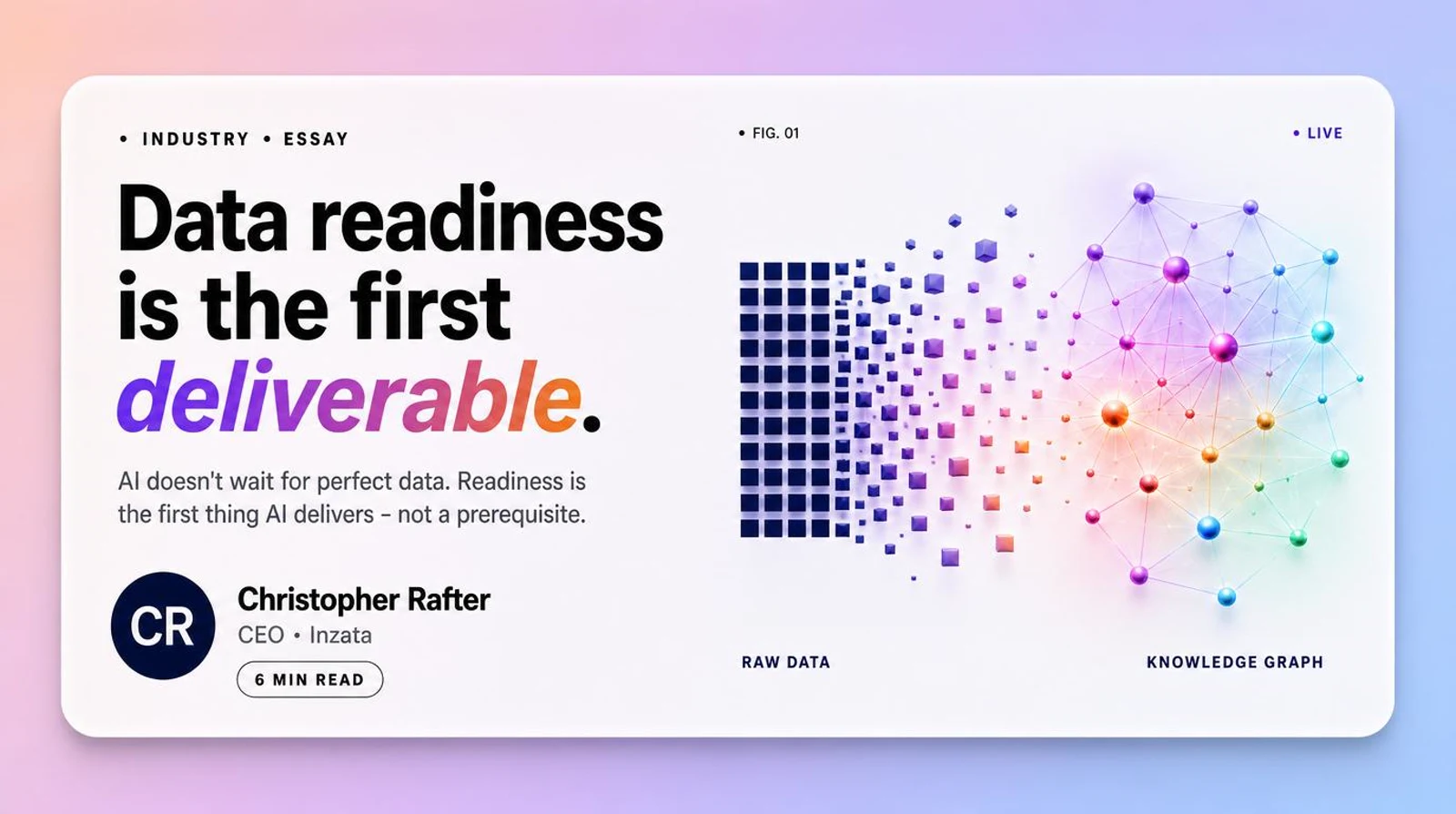
A CIO's playbook for jump-starting AI in a single quarter.
Nearly every CIO I've talked with has some version of the same private conversation:
"I know we're not ready for AI. But I can't be the one who tells the board no."
That's a tough spot to be in. Nobody wants to run headfirst into a jungle of risk, and certainly nobody wants to be the last on the company's AI train. Below is the reframe conversation I keep coming back to in those 1-on-1 discussions, and it's changing how the sharpest CIOs are running their AI programs in 2026:
Data readiness isn't a prerequisite for AI. It's AI's first deliverable inside your company.
That is not wordplay. It's a strategy that lets you say yes to your board today, ship measurable progress in a single quarter, and build an asset that compounds every AI initiative you launch after it. Here is how it works, and how to jump-start it this month.
Good news: your data doesn't have to be 100% ready
The idea that AI needs a pristine data foundation before it can produce anything useful is paralyzing more IT organizations right now than any actual technical constraint. You can use LLMs for a huge range of use cases without touching your core company data at all. Layer in some MCP access, Slack, email, calendar, and you're already producing measurable value with almost no readiness burden.
The "are we ready" conversation is really a conversation about what happens next, when your board asks AI to do something deeper. Observe internal processes. Manage workflows. Evaluate risk. Spot opportunities. That's when the definition of "ready" changes, and it's where the real opportunity opens up.
And you'll be ready to answer the call.
Why 78% of enterprises feel behind
Almost every industry survey right now lands on the same number: around 78% of enterprises say their data isn't ready for AI. That figure gets tossed around like it means "our data is dirty." It doesn't. It means their systems don't share a common understanding of what things are, how they relate, and what the rules of the business are. Their data works fine for humans and dashboards. It falls apart the moment you ask an AI to reason about it.
Here's another secret I'll let you in on: AI doesn't require perfectly "clean" data to work properly. Context is way more important than perfect data.
Not sure? Think about the last time you used ChatGPT or Claude. Did you ever make a typo or misspell something? It still worked, right?
That's because AI isn't code, it's a language model, and unlike code, languages have ambiguity and double meanings. AI doesn't require perfect data quality to deliver its value. It can handle that ambiguity by factoring in context.
For example, if you start a chat with the AI with "I banked...", just like a human, it's going to look at the words around it to determine what you mean.
If it knows you're a pilot and the sentence is "I banked hard to the right," it's going to assume you turned your plane.
If, instead, you said "I banked there when I was in college, but I closed my account when I moved away," it's going to conclude an entirely different kind of banking.
In fact, with the right context and memory, AI is great at working around data quality issues to get to answers. Which means you DON'T need to fix everything before you get started. Just ensure it has proper context.
Data readiness for AI isn't about the data being clean. It's about whether AI can actually understand how your business works.
The department-heads test
Try this at your next leadership meeting: ask each department head for their mathematical formula for Revenue.
- Marketing cares about leads and new business.
- Sales cares about bookings and renewals.
- Ops has its own definition.
- CS cares about retention and upsell.
- Finance cares about revenue and cash flow, equally.
- The CEO cares about EBITDA.
- The board cares about EPS.
Same word. Seven different formulas. Every one of them correct in its context. And none of them are written down anywhere your AI can actually read.
That gap is your opportunity. Not dirty data. Missing context, which is exactly what a knowledge graph is designed to capture and store.
Give it that context, and suddenly AI becomes quite good at juggling your company's seven different definitions for Revenue.
The one thing that unlocks the whole program: a knowledge graph
A knowledge graph is a structured, machine-readable map of how your business works: the entities (customers, orders, employees, contracts), the relationships between them (who sold what to whom, when, and why), and the rules and exceptions nobody ever wrote down. It's the playbook Palantir has ridden to an $80B valuation. It's what Microsoft's GraphRAG research showed drives a 40%+ accuracy lift over standard AI retrieval. It's what Gartner in 2026 labeled a "critical enabler" for enterprise GenAI.
Once you have it in place, every AI initiative in your organization inherits your business context on day one. RAG systems get accurate. Copilots stop guessing. MCP-connected assistants can act, not just answer. Autonomous agents can plan against real constraints. The graph is the multiplier that makes every dollar you spend on AI go further.
How to jump-start it: the move that turns readiness into a board-facing win
Here is the reframe I give CIOs to bring to their board:
"The first thing we're going to have AI do for us is help us get ready for AI."
Read that again, because it's doing more work than it seems like.
The moment you use AI to extract entities, relationships, and rules from your existing systems and documents, and to interview your subject-matter experts to capture their tribal knowledge, you have already crossed the "we're using AI" threshold. You are not deferring the mandate. You are not gate-keeping the board. You are executing it. And the deliverable isn't a proof of concept that gets shelved. It's a durable, compounding asset every future initiative will plug into and use.
Three things happen at once:
- You give the board its AI win. Something is shipping. Something is measurable. Something is defensible.
- You produce the readiness artifact. The knowledge graph IS the readiness. It's not a phase gate before AI. It's the first output of AI.
- You build the compounding foundation. Every subsequent initiative gets faster and more accurate because the graph is already there. And the graph keeps growing every time someone uses it.
That's how you go from "we're not ready" to "we're already shipping AI" inside a single quarter, with an asset that keeps paying dividends every quarter after that.
Tribal knowledge, the accelerator most CIOs underestimate
Tribal knowledge is the stuff floating around your company that nobody thinks of as "data." Why certain customers get exceptions. How quotes really get built. Which SKUs are loss leaders. Why the CFO doesn't count deferred revenue the same way accounting does. It's the difference between an AI that sounds like it has been working at your company for years and one that sounds like it just walked in off the street. A knowledge graph is where tribal knowledge finally becomes structured, queryable, and durable, and the fastest way to capture it right now is to let AI help you extract it.
Where to start this month
You don't need a boil-the-ocean data program. You need a starting point and a compounding asset. In practice, the fastest path looks like this:
- Pick one business unit where the tribal knowledge is strongest. Usually the team with the best record-keeping and the clearest ownership.
- Give them a free AI tool like DataBlueprint that lets them begin documenting their own Knowledge Graph, passively, as they ask and answer questions of their data. Let them ask the questions and let the AI quietly observe, extract entities, relationships, and document unwritten business rules. That's the seed of the graph. Let them ask questions, evaluate results, correct the AI, refine their queries. The more they use it, the richer the Knowledge Graph becomes.
- Ship one visible use case on top of it. A copilot, an analytics agent, a search experience, something the board can see and the team will actually use.
- Expand from there. Every new business unit that plugs in makes the graph, and every downstream AI project, smarter.
The bottom line
Your data doesn't have to be 100% ready. It never will be. But you don't have to wait, either.
Stop framing readiness as a prerequisite. Frame it as your first outcome, delivered by AI itself.
That's the shift the sharpest CIOs are making right now. It's what turns the "we're not ready" conversation into a "here's what we shipped this quarter" conversation. And it's what turns a data program into a compounding strategic asset.
Full disclosure: this is close to what my company builds. We call ourselves the AI that gets you ready for AI, and knowledge graphs are the engine underneath. But the framing works whether you buy or build.
The point is simply this: the CIOs who move first on the knowledge graph will be the ones sitting on an asset that's already returning interest twelve months from now. That's the opportunity in front of you today.