What AI Readiness Actually Means for Small Business
Every AI tool your team tries learns almost nothing about your business. AI readiness is not about picking the right tool. It is about building.
Why AI Tools Give Generic Answers to Business Questions
The most common complaint about AI tools in a business context is that the answers feel generic. Useful for drafting emails. Unhelpful for anything that requires knowledge of your business specifically.
This is not a model quality problem. GPT-4, Claude, and Gemini are all capable of sophisticated reasoning. The problem is context. These models know nothing about your business - your customers, your pricing, your operational patterns, your history - unless you tell them, every single time, in every single session.
A CEO asking "which of my customers are most at risk of churning this quarter?" gets a framework in response, not an answer. The model does not know who your customers are. It does not know your churn signals. It does not know your retention history.
The data that would answer that question exists. It lives in your CRM, your billing system, your support platform, and your operational software. But no AI tool has access to it. That is the AI readiness gap.
What "AI Readiness" Actually Means
AI readiness is not about having the latest model or the newest tool. It is about having a data foundation that any AI can operate against.
The MIT Technology Review reported in April 2026 that by end of 2025, half of companies used AI in at least three business functions - but the biggest obstacle was not model performance, it was the quality and context of the data those systems relied on. AI needs business context to produce business answers.
According to Futurum Research, enterprise leaders increasingly identify the lack of business-specific context as the primary barrier to AI reaching production-readiness. A generic LLM running against generic data produces generic answers. The same model running against a structured, connected representation of your business - a Knowledge Graph - produces answers specific to your business.
For small and mid-market companies, AI readiness means two things: connecting your existing systems so their data is accessible, and building the relationships between records so AI can reason across them.
The Knowledge Graph as AI Foundation
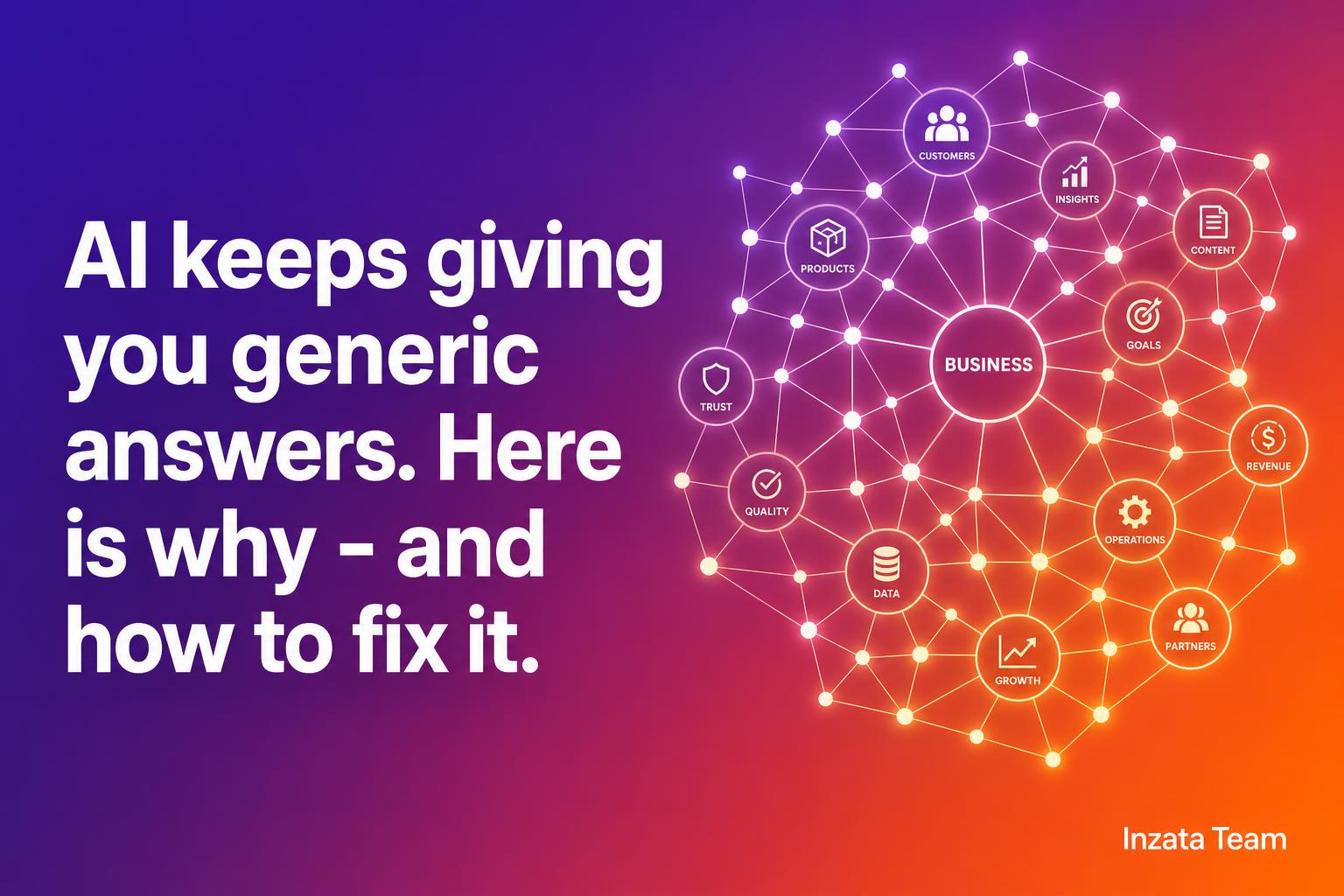
A Knowledge Graph is a structured map of your business data - the entities (customers, jobs, invoices, employees, transactions), the relationships between them, and the context that gives those relationships meaning.
When AI runs against a Knowledge Graph, it is not searching through unstructured text. It is reasoning against a model of your business. "Which customers are growing?" becomes an answerable question because the Knowledge Graph holds customer revenue history, job frequency, and payment patterns - all connected, all queryable.
DataBlueprint builds this Knowledge Graph automatically from read-only connections to your existing systems. QuickBooks, your CRM, your operational software, your scheduling platform. The Knowledge Graph maps how records across all of them relate. No data engineering. No data warehouse. The platform builds the model.
On top of that Knowledge Graph, a private LLM powered by AWS Bedrock answers business questions in plain English. The answers are sourced - every figure traces back to the specific rows in your systems that produced it. There is no hallucination without a source to contradict it.
What Changes When AI Knows Your Business
The difference between an AI tool that knows nothing about your business and one that runs against your Knowledge Graph is the difference between a framework and an answer.
Without a Knowledge Graph, "which customers should I call this week?" gets a list of criteria for identifying at-risk accounts. With a Knowledge Graph, it gets a list of your actual customers, ranked by churn signal, with the data behind each one.
Without a Knowledge Graph, "why did margin compress last quarter?" gets an explanation of what typically causes margin compression. With a Knowledge Graph, it gets the specific job categories, customer mix changes, and cost line items in your QuickBooks that drove the compression.
AI readiness is not about deploying the best model. It is about giving any model the business context it needs to produce answers instead of frameworks. DataBlueprint builds that context - automatically, from the systems you already run.
Your data never leaves your environment. The private LLM powered by AWS Bedrock answers questions privately, without your business data transiting shared AI infrastructure.
Where to Start
AI readiness for a small or mid-market company does not require a data team, a data warehouse, or a multi-year migration. It requires connecting your existing systems read-only and letting a platform build the Knowledge Graph automatically.
DataBlueprint connects your first system in under 3 minutes. The Knowledge Graph builds from there. Your first business-specific AI answer is available the same session.
The companies that win the AI transition are not the ones with the largest AI budgets. They are the ones whose data is connected, contextualized, and ready to answer the questions that matter.
Why do AI tools give generic answers to business questions?
Generic AI tools have no knowledge of your specific business - your customers, transactions, operational history, or patterns. They answer from general knowledge, not from your data. The result is frameworks and suggestions, not specific answers. AI readiness means connecting your business data so AI can reason against it.
What is a Knowledge Graph and why does it matter for AI?
A Knowledge Graph is a structured map of your business data - the entities (customers, jobs, invoices, employees), the relationships between them, and the context that makes those relationships meaningful. AI running against a Knowledge Graph produces business-specific answers. AI running against nothing produces generic ones.
Do I need a data team to build a Knowledge Graph?
No. DataBlueprint builds the Knowledge Graph automatically from read-only connections to your existing systems. There is no data engineering, no data warehouse design, and no ETL pipeline to maintain. The platform handles it.
How is DataBlueprint different from ChatGPT or Copilot for my business?
ChatGPT and Microsoft Copilot are general-purpose AI tools. They do not connect to your operational systems and do not build a model of your specific business. DataBlueprint connects to your systems read-only, builds a Knowledge Graph specific to your business, and runs a private LLM powered by AWS Bedrock against that graph. Every answer is specific, sourced, and traceable.
How long does it take to get my first business-specific AI answer?
Connect your first system in under 3 minutes. The Knowledge Graph builds automatically. Your first business-specific answer is available the same session.
Generic AI gives you frameworks. DataBlueprint gives you answers. Connect your first system, build your Knowledge Graph, and ask your business the questions it has never been able to answer in real time.
Frequently Asked Questions
Why do AI tools give generic answers to business questions?
Generic AI tools have no knowledge of your specific business - your customers, transactions, operational history, or patterns. They answer from general knowledge, not from your data. The result is frameworks and suggestions, not specific answers. AI readiness means connecting your business data so AI can reason against it.
What is a Knowledge Graph and why does it matter for AI?
A Knowledge Graph is a structured map of your business data - the entities (customers, jobs, invoices, employees), the relationships between them, and the context that makes those relationships meaningful. AI running against a Knowledge Graph produces business-specific answers. AI running against nothing produces generic ones.
Do I need a data team to build a Knowledge Graph?
No. DataBlueprint builds the Knowledge Graph automatically from read-only connections to your existing systems. There is no data engineering, no data warehouse design, and no ETL pipeline to maintain. The platform handles it.
How is DataBlueprint different from ChatGPT or Copilot for my business?
ChatGPT and Microsoft Copilot are general-purpose AI tools. They do not connect to your operational systems and do not build a model of your specific business. DataBlueprint connects to your systems read-only, builds a Knowledge Graph specific to your business, and runs a private LLM powered by AWS Bedrock against that graph. Every answer is specific, sourced, and traceable.
How long does it take to get my first business-specific AI answer?
Connect your first system in under 3 minutes. The Knowledge Graph builds automatically. Your first business-specific answer is available the same session. --- Generic AI gives you frameworks. DataBlueprint gives you answers. Connect your first system, build your Knowledge Graph, and ask your business the questions it has never been able to answer in real time. [Start for Free](https://app.inzata.ai/register) - [See how it works](/how-it-works)