How CPA Firms Answer Client Questions Faster
CPA firms spend hours pulling data their clients already expect them to have. Here is what changes when your systems connect instead of export.
The Data Problem CPA Firms Don't Talk About
CPA firms hold more client data than almost any other type of business. QuickBooks files, tax returns, payroll records, engagement data in Practice CS or Karbon - it is all there. The problem is not access. The problem is that none of it talks to the rest of it.
A client calls asking why their gross margin dropped last quarter. The answer exists - it is in their QuickBooks file, their payroll records, and the job data from their operational system. But accessing it requires opening QuickBooks, pulling a P&L, cross-referencing it with a payroll export, and building a reconciliation in Excel. That process takes two to three hours for a question the client expects answered in a conversation.
This is the data problem CPA firms do not talk about. Not that the data is missing, but that the data is trapped, and every question requires a manual expedition to find it.
What Clients Are Actually Asking
The questions clients ask their CPA firms have changed. A decade ago, the engagement was primarily backward-looking: file the return, reconcile the books, prepare the statements. Clients wanted compliance.
Today, clients want answers. They want to know why revenue is up but cash is tight. They want to know which service lines are carrying the firm. They want to know whether to add headcount or defer it. They want their CPA to be a decision partner, not just a historian.
These questions are answerable from the data CPA firms already hold. The barrier is not data availability - it is data accessibility. The systems that hold the answers are siloed, and the process of connecting them manually is too expensive to do for every client call.
Why Practice CS and QuickBooks Don't Solve It Together
Practice CS manages the engagement. QuickBooks holds the financials. They are both essential, and they do not talk to each other in any analytical sense.
Transaction-level syncs move data between systems for accounting purposes. But "which clients grew revenue last quarter while also increasing their unbilled hours?" is not a transaction-level question. It is a cross-system analytical question that requires both systems to be queryable together.
Without a layer that maps the records in Practice CS to the records in QuickBooks, that question requires a manual export from both, a join in Excel, and 45 minutes of work - for every client it applies to.
The same is true when adding payroll data, tax return history, or operational systems the client runs. Each additional system adds another silo. Each silo adds another manual step.
What Connected Systems Look Like for a CPA Firm
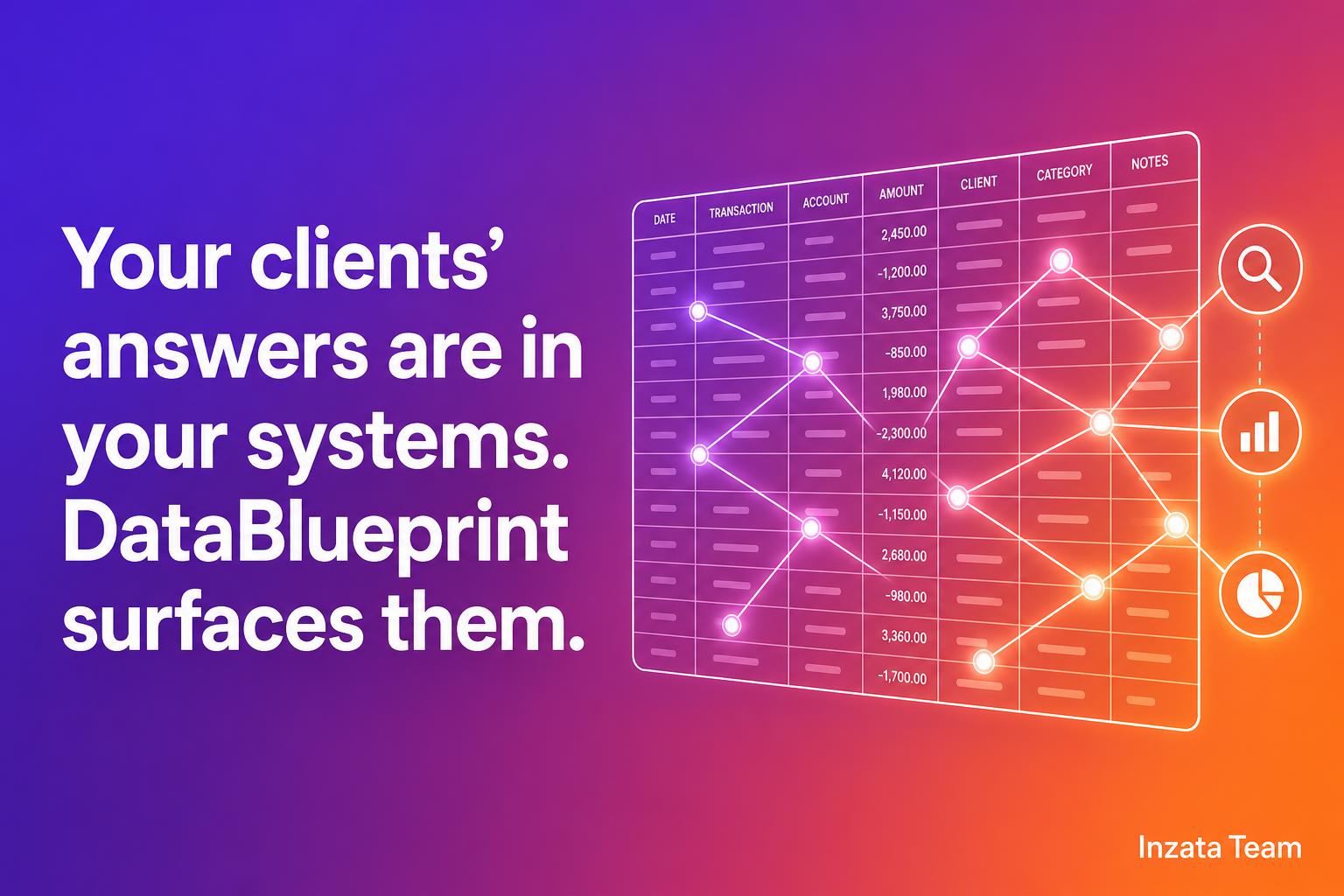
DataBlueprint connects your systems read-only - QuickBooks, Practice CS, Karbon, payroll platforms, and client operational software - and builds a Knowledge Graph that maps how clients, engagements, transactions, and records relate across those systems.
A partner at the firm can ask "which clients had revenue growth above 20 percent last year but margin compression?" and get a sourced answer in seconds. The answer traces back to the exact QuickBooks records and engagement data that produced it.
A client on the phone asking why their cash position is tighter than their P&L suggests gets an answer in the conversation, not 48 hours later after a manual analysis.
Your clients' data never leaves your environment. The private LLM powered by AWS Bedrock answers questions against it without the data transiting shared infrastructure. AWS Bedrock contractually guarantees your inputs and outputs are never used to train or improve foundation models.
This is the distinction between a firm that answers client questions and a firm that gets back to clients. In a market where advisory services are the growth engine, that difference is material.
What systems do most CPA firms run that DataBlueprint connects?
Most CPA firms run QuickBooks (for client accounting), Practice CS or Karbon (for practice management), and a payroll platform. DataBlueprint connects all of these read-only and builds a Knowledge Graph that maps how clients, engagements, transactions, and records relate across them.
How does DataBlueprint handle client data confidentiality?
DataBlueprint uses read-only connections - it cannot write, modify, or delete any record. Client data stays in your environment. The private LLM powered by AWS Bedrock answers questions without the data leaving your environment or transiting shared AI infrastructure.
Can DataBlueprint answer questions across multiple client QuickBooks files?
Yes. DataBlueprint can connect to multiple QuickBooks entities and map relationships across them. This enables firm-level views - like which clients are growing, which are at risk, and how your practice is performing across the portfolio.
How long does it take for a CPA firm to get its first answer?
Most connections are live within 3 minutes. The Knowledge Graph builds automatically. Your first cross-system answer is available the same session.
Is DataBlueprint a replacement for Practice CS or Karbon?
No. DataBlueprint reads from your existing systems. Practice CS and Karbon continue to manage your engagements. DataBlueprint adds the decision layer that answers cross-system questions those platforms cannot.
CPA firms that answer client questions in the conversation, not 48 hours later, win more advisory mandates. DataBlueprint connects your systems and makes every client question answerable in seconds.
Frequently Asked Questions
What systems do most CPA firms run that DataBlueprint connects?
Most CPA firms run QuickBooks (for client accounting), Practice CS or Karbon (for practice management), and a payroll platform. DataBlueprint connects all of these read-only and builds a Knowledge Graph that maps how clients, engagements, transactions, and records relate across them.
How does DataBlueprint handle client data confidentiality?
DataBlueprint uses read-only connections - it cannot write, modify, or delete any record. Client data stays in your environment. The private LLM powered by AWS Bedrock answers questions without the data leaving your environment or transiting shared AI infrastructure.
Can DataBlueprint answer questions across multiple client QuickBooks files?
Yes. DataBlueprint can connect to multiple QuickBooks entities and map relationships across them. This enables firm-level views - like which clients are growing, which are at risk, and how your practice is performing across the portfolio.
How long does it take for a CPA firm to get its first answer?
Most connections are live within 3 minutes. The Knowledge Graph builds automatically. Your first cross-system answer is available the same session.
Is DataBlueprint a replacement for Practice CS or Karbon?
No. DataBlueprint reads from your existing systems. Practice CS and Karbon continue to manage your engagements. DataBlueprint adds the decision layer that answers cross-system questions those platforms cannot. --- CPA firms that answer client questions in the conversation, not 48 hours later, win more advisory mandates. DataBlueprint connects your systems and makes every client question answerable in seconds. [Start for Free](https://app.inzata.ai/register) - [See our connectors](/connectors)